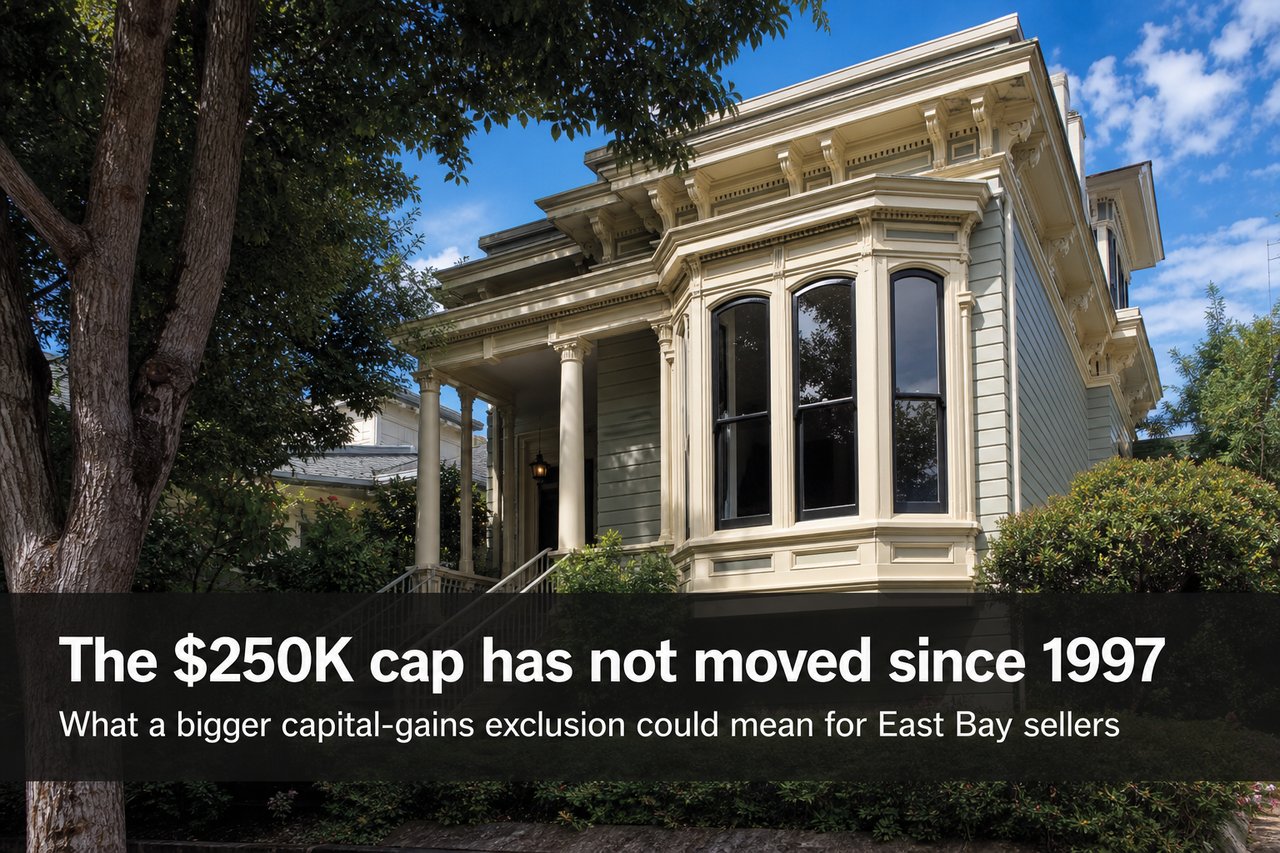
If you bought your East Bay home in the 1990s or early 2000s, the number that matters at sale is often not the list price. It is the federal capital gains exclusion, and it has not moved since 1997: $250,000 for a single filer, $500,000 for a married couple filing jointly.
A bipartisan bill in Congress, the More Homes on the Market Act (H.R. 1340), would double those caps to $500,000 and $1 million and index them to inflation. It is not law. It is still in committee. As of August 2026 it had about 174 co-sponsors in the House and Senate combined.
Here is what East Bay sellers should actually know.
What the law is today
If you have owned and lived in your primary home for at least two of the five years before you sell, you can exclude up to $250,000 of gain (or $500,000 if married filing jointly) from federal income tax. Gain above that can be taxed at long-term capital gains rates.
Those 1997 numbers were written when a typical U.S. home sold for about $145,000. In much of the East Bay, a house bought for $250,000 twenty-five years ago can sell well above $1 million. That is how a family that is not "wealthy" on paper still walks into a tax bill when they try to downsize.
This is not tax advice. Run the numbers with your CPA before you list.
What the bill would change
H.R. 1340 would raise the exclusion to $500,000 (single) and $1 million (married filing jointly) and adjust those amounts for inflation going forward. Sponsors say that would unlock homes that long-time owners are holding because selling would trigger a large tax. Critics say most of the benefit would go to higher-value markets, which includes us.
Either way, it is a proposal. Do not list, delay, or reprice a home on the assumption it will pass.
What it could mean in the East Bay
If the caps rose, some owners who have been waiting might test the market. More listings would help buyers. For sellers, a larger exclusion could change the "can we even afford to move?" math, especially in Richmond, El Cerrito, Oakland, and the rest of West Contra Costa where long-time owners are sitting on decades of appreciation.
It would not fix pricing, condition, or presentation. If a home is sitting, the first lever is still comps and condition, not Congress. We wrote about that here: Should You Lower the Price or Offer a Buyer Credit?
What to do now
- Know your basis (what you paid, plus documented improvements).
- Ask your tax pro what you would owe under today's $250K / $500K caps.
- If you are thinking of selling in the next 12 months, plan the listing around the market, not a bill in committee.
- If you are waiting only for this bill, have a backup date. Bills stall.
FAQ
Is the More Homes on the Market Act law yet?
No. H.R. 1340 has been referred to the House Ways and Means Committee. It has not been signed.
Would it double my exclusion?
For a qualifying primary residence, the bill would raise the caps to $500,000 (single) and $1 million (joint) and index them. You would still need to meet the two-out-of-five-years use-and-ownership test.
Should I wait to sell?
Not automatically. Inventory, rates, and your next housing cost matter more than a bill that may not pass this year. Get a neighborhood-level number first.
If you want a read on what your East Bay home could list for under today's rules, talk to us. Bring your tax person into that conversation.
LaDonna Azagra DRE 01899394 | Carlos Ramirez DRE 01781308
510-725-8885 | [email protected] | www.theazagragroup.com